

What is Algo Trading?
Actually, on 28th March 2015, Dana Macaulay, a Wall Street Journal reporter, tweeted that Intel is in talks to buy Altera. Just a second after this tweet, an option trader, whose name is not publicly available, bought Altera’s out-of-the-money option at a rate of $0.35. And only 28 minutes later, when the option price reached $8.5, he sold it, earning $2.4 million.

But the main point is, how can someone take a trade in just a second? We take out 2-4 minutes to think. And even if we don’t add the time to think, when we buy a stock or take a trade, we first enter the quantity, then click Buy, then click Confirm Buy. Even then, it will take 35-40 seconds.
So how did he take the trade in a second? It is not possible to take a trade manually in a second. But it can be done through algorithmic trading. And that option trader used algorithmic trading.
Understanding the Basics
So, friends, ‘algo trading’ is made up of two words. Algo means algorithm. It means to perform a mathematical operation. For example, 2 plus 2 is also an algorithm. And when we use these rules to trade, then it is called algo trading.
In algorithmic trading, based on variables such as time, price, and volume, a set of rules is defined and a computer program is developed. And it is used for trading. I know you might not have understood much. But don’t worry, there is no need to understand more than this.
Because a program is made, understanding how it works is more important than understanding its use. So these algorithms, i.e. computer programs, when traders trade using them, it is called algo trading. The advantage of this is that you can trade at speed.
Like that, an option trader traded in just one second. And secondly, it has high accuracy. Which makes it very important for the big traders. Because if the money goes up or down, they can lose millions of crores.
Do you think these institutional investors or hedge funds trade manually, like we do? No, they use specialised software to execute their trade. Because the capital of these institutions is very high.
Manual trading isn’t feasible for institutions with large capital, so they use algorithms. Here’s a simple example:
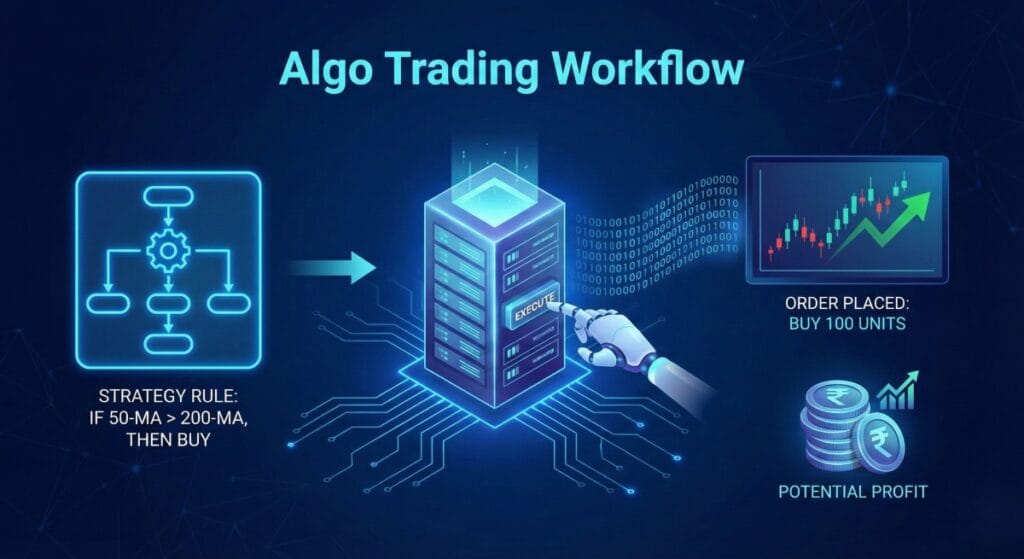
- Suppose you make such a program in which you keep the logic that whenever a stock’s 50-day moving average crosses over its 200-day moving average, then you have to buy 100 units.
- When this condition is met, your 100 units are bought instantly.
- This brings both speed and accuracy.
So when we make such rules, they become algorithms. And on the basis of these rules, algorithmic trading works. Now, regarding its legality, algorithmic trading is completely legal in India. And it is also regulated by SEBI.
First of all, algorithmic trading started in 2008. But then, only institutions used to trade through it. But since 2016, it has also been open to retail investors. And today, more than 50% of market liquidity comes from algorithmic trading.
But in the USA, this number is 70%. Now, if we talk about legality, then let’s know how to use it. So, friends, at present, apart from Zerodha, Upstox, and Angelone, many brokers have launched APIs (Application Programming Interfaces) that allow retail traders like you and me to do algo trading.
How to Start
A comparative table indicates which brokers provide API trading platforms. For example, Angelone offers this service for free and allows you to open a free Demat account.
Now, let’s assume that you want to do algo trading through Angelone. For this, you have to sign up on Angelone’s Smart API website. The sign-up process is very easy. After that, you have to click on Create an App.
There, you can choose the trading API. After that, when you fill in the remaining details and click on Create an App, you will get your API key. You can further integrate it into your app or MT4 software.
For this, you will need coding knowledge, or you can also hire a coder. Now you understand the process of algorithmic trading. Now, let’s understand some of its strategies.
Key Strategies
- Systematic Trading: In this, strategies are framed keeping macroeconomic factors in mind. In this, technical indicators, volume, and risk-reward ratio are considered, and trades are placed in the direction of the market’s move. Generally, hedge funds use this method. If we can formulate it correctly, our capital will also move in the direction of the funds flowing into institutions. This can be very profitable.
- Momentum Trading: Similarly, momentum trading is a systematic trading approach. If you want, you can also follow that strategy.
- Index Arbitrage/Events: In the second strategy, as you all know, mutual funds also invest in indexes like NIFTY and SENSEX. So whenever a stock is included in an index like NIFTY or SENSEX, it indirectly gives mutual funds’ capital to that stock. So if a stock is included or excluded from an index, you can take a bullish position in the included stock and a bearish position in the excluded stock. You can also design an algorithm for this.
- Mean Reversion: The third strategy is mean reversion. The law of mean reversion is a mathematical model. Regarding the stock market, let me explain this law to you. It says that the thing that goes up also goes down, and the thing that goes down also goes up.
So if a stock’s price is lower than its average price, then its price can go up, and if a stock’s price is higher than its average price, then its price can come down. To use this strategy, you can also use the moving average indicator. - Scalping: The fourth strategy is scalping. You must have noticed that there is a slight difference between the buy and ask prices. So you can take advantage of this difference to do trading. But because these trades last only a few seconds to a few minutes, that is, they are very short, we need computer programs to execute them.
Exchange developer orders are executed only when the bid price and ask price match. So the minute difference is scaled using this.
So you can use these strategies to trade.
Pros and Cons
Now, if you are new to trading or you trade with a little capital, then you don’t need much algorithmic trading right now. But no doubt, if you make a good algorithm, you can make a lot of profit because everything will be automated.
Advantages:
- Accuracy: Apart from this, its first advantage is that the trades placed through it are highly accurate because they are executed by computer programs, ensuring consistently high accuracy that humans cannot match.
- Volume: Second, a large number of trades can be executed through this, which is very helpful for institutional investors.
- No Emotions: Third, there are no human emotions involved. So the stop-loss you used to avoid losing, that mistake will not be here. So you will not spoil your trade due to emotions.
- Back-testing: And fourth, many strategies can be back-tested, which lets us see how effective they are, and based on that, we can build an algorithm that profits automatically.
SAlgo trading offers significant benefits, but there are also potential drawbacks to consider.Disadvantages:
- Technical Glitches: For example, due to technical issues, the trade cannot be executed, resulting in a significant loss.
- Market Volatility: In addition, because it is based on mathematical and historical data, it cannot anticipate significant market shifts that could cause the share price to rise or fall, resulting in a loss.
- Unregulated Platforms: Apart from this, a very important thing no one will tell you is that many market participants build their own API platforms and promise that their strategies can deliver very high returns.
Even as the number of unregulated platforms has increased, SEBI said in December 2021 that all API platforms must obtain SEBI authorisation. Now, because algorithmic trading is not yet for retail investors, people can also trust them. If you search on Google, you will find many such platforms.
So if you are thinking of doing algo trading, keep in mind whether the platform you are trading on is safe and regulated. So finally, although algorithmic trading is a new concept for retailers, it is slowly gaining popularity. And because many brokers are providing trading APIs to their clients with pre-formulated strategies, its popularity can increase even further.
But if you want to make your own strategy and do algo trading, you should either know how to code or hire a developer, which is a little difficult and costly. But as the number of market participants increases, the cost structure will also decrease. So, all in all, it now seems that algorithmic trading is the future.
Best Algo Trading Platforms in India for 2026
Automation is increasingly becoming the standard for traders seeking to remain competitive in 2026, reducing the risk of missed opportunities while away from the trading interface. But with so many algorithm platforms in India, how do you know which one truly delivers? We’ll dive into their features, pricing plans, and ideal user profiles. Whether you’re a beginner or a pro, this comparison will help you automate smarter.
Let’s find the platform that best fits you.
Streak by Zeroda
First up is Streak by Zeroda, a favourite for traders who want to ease into algo trading without touching a single line of code. The interface is super user-friendly.
- Just type conditions like ‘buy when RSI crosses 30,’ and the system turns them into an executable strategy.
- It allows you to backtest, paper trade, and deploy live strategies.
- Plus, it syncs beautifully with Zeroda’s kite platform for seamless execution.
- There’s a free plan with basic limits, while premium plans start at just 500 rupees per month.
For beginners and semi-active traders, this is one of the easiest ways to start.
Tradetron
Next up is Tradetron, arguably the most versatile algo trading platform available in India today.
- Whether you’re a complete beginner or a full-time quant, Tradetron gives you the power to build, deploy, and even sell your own trading strategies, all without writing a single line of code.
- It supports complex, multi-leg, multi-asset strategies complete with if-then-else logic, allowing detailed customisation based on real-time market conditions.
- You also get access to a built-in marketplace, where you can subscribe to pre-built strategies from top traders or monetise your own by offering them to others.
- Tradetron integrates with over 25 brokers, giving users incredible flexibility and freedom.
- ver Pricing starts with a free plan offering limited features, and premium plans go from 300 to 15,000 rupees per month, depending on your needs.
AlgoBulls
Finally, there’s AlgoBulls, a smart algo trading platform designed for those who want automation with a professional touch.
- AlgoBulls offers ready-to-use, expert-curated strategies, including intraday, positional, and options-based models.
- Its standout feature is the Strategy Engine, which is research-backed and gives you access to institutional-grade logic without needing to design anything yourself.
- You also get real-time backtesting, paper trading, and Auto-trading.
- AlgoBulls Supports big names like like Zerodha, Upstox, and AngelOne.
- Pricing starts at about 500 rupees per month, with Upgrading unlocks more and advanced strategies.
Here’s the verdict? Choose Streak if you’re new and want something simple that works well with Zerodha. Go for Tradetron if you want a marketplace, Custom rules, and support for many brokers.
Pick AlgoBulls if you want Built by experts strategies that Ready to go. It comes down to what you need and how hands-on you want to be.