
Gold, Silver, and the Historic Rise: A Comprehensive Market Analysis
Introduction to the Investment Opportunity
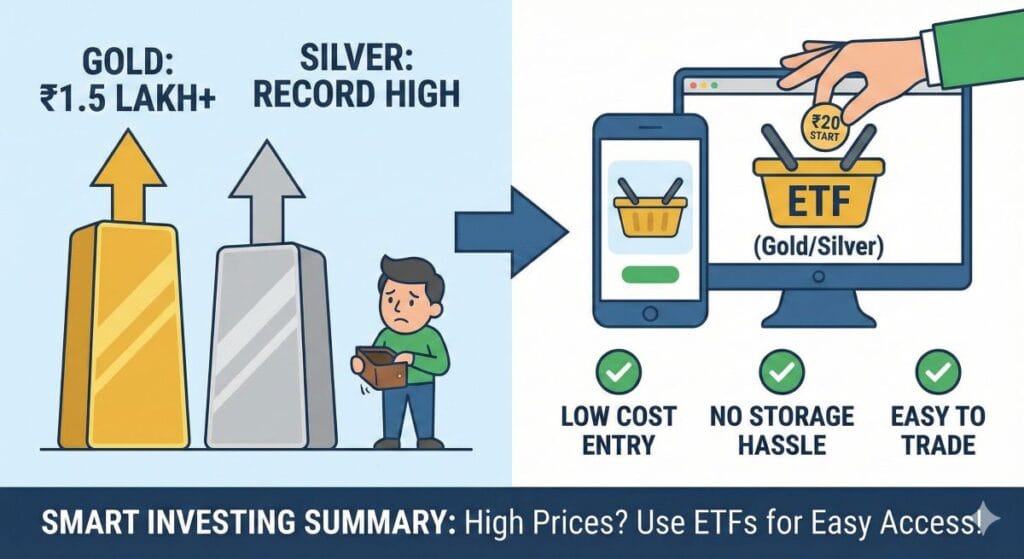
Start investing in gold and silver without worrying about charges, storage, or maintenance. You don’t need thousands of rupees to start; just 20 to 30 rupees. Let’s see how.
Record-Breaking Market Trends
Let’s start with the latest data on gold. According to MCX, on 23 January, a gram of 24-carat gold cost Rs. 15,900. Over the last 10 days, the price has returned about 11%.
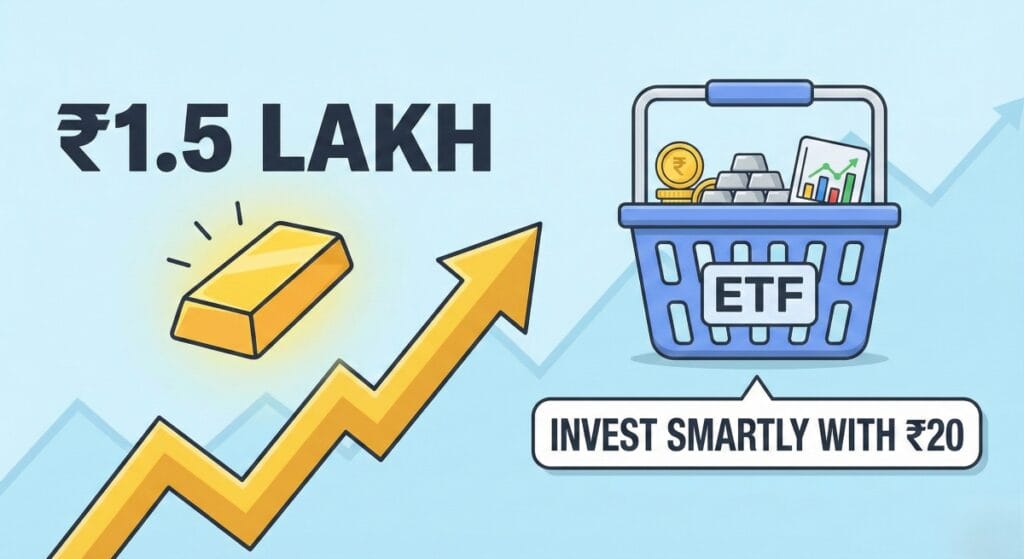
Back in the first week of September, we discussed that 10 grams of gold would reach 1.5 lakhs. Now, that prediction has come true. As of 27th January 2026, the price of 10 grams of gold on MCF has crossed 1,52,000.
Now, let’s look at silver. Today, a kilo of silver reached Rs. 3,40,000. Over the past 10 days, the return has been 17%. In the global market, silver has risen above $ 4,730. The market is moving quickly and shows no signs of slowing down.
Why Prices Are Rising
There are several reasons for these rising prices. The main factor is global uncertainty and growing tensions. Geopolitical issues are widely discussed in the worldwide market and have a substantial impact on prices.
Concerns about a trade war between America and Europe have also unsettled the market. Disputes over Greenland, sparked by Trump’s claims, have further influenced market sentiment.
Another reason is the weak dollar. When the dollar falls, gold and silver become cheaper and more attractive to foreign investors, which pushes prices up. Also, when stock and bond markets are unstable, people turn to gold and silver for security.
Silver also has growing industrial demand, especially for use in solar panels and electric vehicles. However, the supply remains limited.
The Strategy: Investing Without Physical Ownership
Now let’s come to the question of investment. What is the method by which you can invest in gold or silver without buying it directly? The answer is ETF, Exchange Traded Fund. An ETF is a fund in which many shares, bonds, gold, or any commodity or index are packed together, and you buy a small part of the whole package.
ETFs can be bought and sold easily like shares in the stock market. Just like you buy a share of Reliance or TCS, you can buy a gold ETF, a silver ETF, or a Nifty ETF. The only difference is that the share is of one company, whereas the ETF is a basket of many companies. If the market is open, you can buy and sell at the prices that are changing.
ETF vs. Physical Silver: A Detailed Comparison
Why is ETF so popular in gold and silver? If you search, you will find ETF everywhere. For example, let’s talk about a silver ETF and understand the difference. What is the difference between investing in a silver ETF and buying physical silver? One by one.
- Ownership: The first is ownership. In an ETF, you don’t keep the physical bar of silver with you. You keep it in digital form, like a unit that represents silver. You can say that this is my share, but you don’t have the real silver. The safe fund-managing company keeps it in its vault. At the same time, physical silver, such as silver coins, bars, bands, or jewellery, also exists. You have to keep it safe with you.
Liquidity and Trading: Next is liquidity and trading. You can easily buy and sell ETFs in the share market like Reliance and TCS shares. When the market is open, it is a straightforward and quick way to get live prices. To sell physical silver, you have to go to a jeweller or dealer. You have to get the purity test done. You have to ask for the price, and you might have to wait. It takes time to sell, and prices can differ.
Purity and Storage: Next is purity and storage. Silver held in an ETF is usually 99.9% pure. It is professionally stored in a vault. You don’t have to worry about its purity. On the other hand, in physical silver, you have to find out how pure it is. After that, you store it at home, in a locker, or in a safe place. It has the risk of theft or loss.
Minimum Investment and Transparency: After that comes minimum investment and transparency. In an ETF, you can start with tiny amounts. Even with 20-30 rupees. As we told you, you are not buying by the gram or the kilo. You are purchasing a small portion of the entire basket. And every company distributes its ETF according to its own share. But to buy physical silver, you have to pay more upfront. Apart from this, prices can vary across cities. Prices are not the same.
Understanding Costs, Expense Ratios, and Returns
Now let’s talk about expenses and costs. In an ETF, you pay management fees, called the expense ratio. The expense ratio includes import duty, GST, vault storage costs, etc. There is also a tracking error in this. We will understand the meaning of both of these in a while. For now, you have to pay both the expenses when you buy an ETF. This is a small percentage of your total portfolio.
Now let’s talk about the physical silver cost. In that, you have to pay making charges, GST, dealer spread and storage cost.
Yesterday, on January 22, there was news in the market that both gold and silver had broken. Gold was down 3%, and the silver ETF was down 10-20%. Then there was a question. If every silver ETF is investing in pure silver… As silver’s price changes, the ETF’s cost lags behind it. Then how can the returns of two companies’ silver ETFs be different? The answer to this is expense ratio and tracking error.
As we told you, you have to pay both these expenses when you buy an ETF. ETFs have expenses such as GST on silver, import duties, silver storage, and fund managers’ fees. Assume that one ETF spends 0.3% each year, and the other spends 0.6%.
You might think that the difference is negligible. But over time, the same expense is reflected in your return. This means that the ETF with a higher expense ratio will earn less even if silver prices are rising.
Now, let’s talk about tracking error. How honestly can an ETF track or follow the real price of silver? This is called tracking error. In an ideal case, the cost of silver and ETF should run together. But in reality, this does not happen every day. Sometimes, the ETF lags. Sometimes, it goes ahead. This is called tracking error.
With all these expenses in mind, the ETF’s price is calculated. Add the ETF’s total silver price. Subtract the expenses from it. After that, divide it into total units. Since daily expenses like buying and selling, taxes, etc., keep changing.
This affects the ETF’s total return. That’s why the ETF can’t keep up with silver’s current price. If the expense ratio of a silver ETF is high, and the tracking error is also high. Then the ETF will give a lower return than silver. That is, silver increased by 10%, but your ETF increased by 8-9%. The ETF with a low expense ratio and low tracking error will deliver better returns.
Future Outlook: What lies ahead?
So now it’s a fact that you have to pay more than 1.5 lakhs to buy 10 grams of gold. But the question is, are these prices going to increase further? What is the next level after 1.5 lakhs? This is a huge question. The reason is that the global market situation is such that prices can be anything.
But you should be alert. On the global front, if all these reasons are a bit cold, you will see a significant correction. But the fundamentals of the market are powerful overall. And now, gold has risen to 1.5 lakhs.
How to Buy
How to buy an ETF? For this, you need a Demat account. If you search for an open Demat account on Google, you will find many brokerage companies and bank options.