
The Dual Pillars of Profitable Trading: Technical Mastery and Capital Psychology
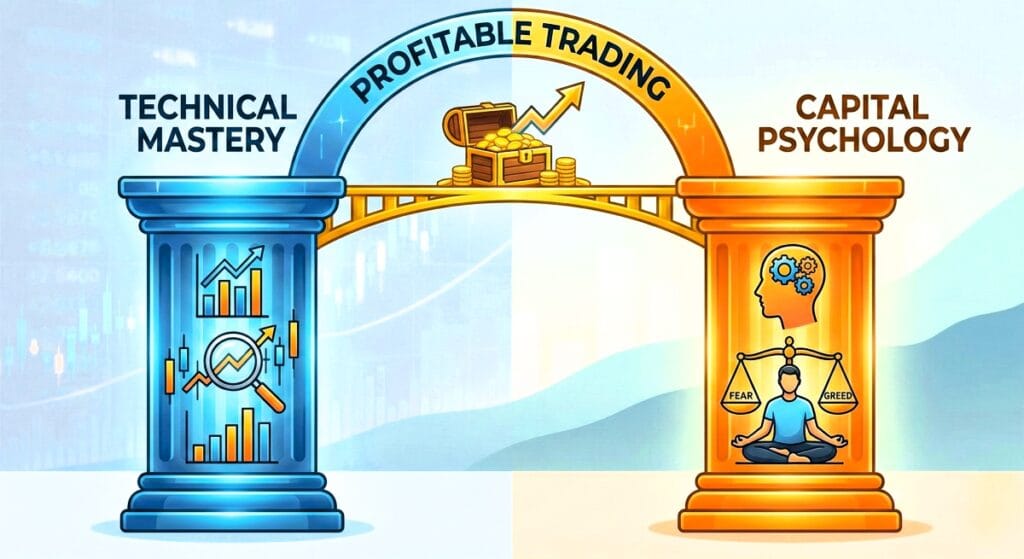
There are two different parts in trading. The first part is purely psychological, and the second is purely technical. To achieve consistent profitability, we must master both domains. This guide details how to strip away market noise to focus on the essential technical components—Price Action and Volume—and how to build a mental model that allows you to scale your capital without becoming a slave to it.
Part 1: The Technical Foundation
Simplifying the Market
In the technical part, we should focus on two things: price action and volume. We should put full energy into those two things, from which there is a possibility of getting very good results.
Many new traders, when they start, pay close attention to indicators. They add a magical element to the market, telling them when to buy and when to sell. But you should know that there is no such thing in the market; no magical indicator, no magical formula. When I started trading 8 years ago, my chart was also full—a lot of indicators, a lot of lines. I could not even understand what the right entry point was, what the exit point was, or how to manage the position.
Over time, I came to understand that so many indicators and tools only become noise. In the end, everything comes down to two things: first, price action, and second, volume. If there are a lot of lines on your chart, remove them one by one.
The Truth About Indicators
Let’s talk about the popular indicators like RSI. People say that if RSI is above 70, sell it; if it is below 30, buy it. Now, here’s one thing you should understand deeply: RSI is a lagging indicator. In reality, most indicators are lagging. Lagging means that the price moves first, then the indicators follow. That’s why the indicator always lags a little; indicators react a little later.
The two things that will always be ahead are price action and volume. These are the two things that give you real-time signals. The remaining indicators should be used only for confirmation, not for decision-making.
Understanding Volume and Aggression
To understand who is strong—buyer or seller—and who is more aggressive, we start with the basic components.
There is a big misconception here that most people misunderstand: that the volume shows whether the buyers are more or the sellers are more. But the truth is that in the market, for every transaction, there is one buyer and one seller. When you see that the volume is 1, it means there is one buyer and one seller who have agreed on a price, and a transaction has occurred. If you see a volume of 10, it means 10 shares or 10 contracts were transacted at a single price. This does not mean that 10 buyers or 10 sellers are more; this means that one side sold 10 and the other side bought 10, which together becomes 10 volume.
What is really present is who is more aggressive: buyer or seller. The thing that we can understand from volume is whether the buying side is more aggressive or the selling side. This is actually the most important thing, as seen from the volume.
Auction Market Theory
To understand who is stronger in the market, we use a concept which we call Auction Market Theory. The whole market is of one kind: an Auction Place where buyers and sellers meet. They both try to find a price equilibrium between them. In every transaction, an attempt is made to balance this.
This relates to the concept of Bid and Ask. There are some people in the market—traders, institutions—placing orders. This order can be placed in two ways: either as a market order or as a limit order.
- Aggressive Orders: If a person is selling at the market, they are an aggressive seller. If someone is buying at the market, they are an aggressive buyer. It means that, regardless of the market order, he is aggressively hitting the price.
- Passive Orders: On the other hand, if someone places a limit order, it will appear on either the bid or the ask side.
Linking Price, Value, and Volume
Assume a financial instrument is rising. It means that its price is increasing. And along with that, its value is also increasing. This means the buyer is interested in a higher price level; there is buying support at the current market level.
However, if the price is rising but the value is flat or declining, it means there is no interest in that higher price level. It means that the buyer is not very interested in that new price level. But if both the price and value are rising, it means the market is showing interest in that level.
Volume is not just a number. It tells us whether interest increases with price. That is why volume should always be given equal importance as the price action.
Price Action: The Language of the Market
For me, price action has always been the king. I like to see what the price is telling me. What signal is the market giving? Which price is it accepting? In which direction is the market moving?
Price action is the language of the market. Its main purpose is to understand where the market’s strength lies. Where is the market comfortable in trading? Observing the candlestick, identifying the supply and demand zones, understanding the support and resistance—all these pieces should be joined together.
When we combine price action and volume, we gain a deep understanding of the market. We understand what the market is saying. Is the market really strong? Is the market really trending? Is it really a strong breakout or breakdown? Or is it just a trap that can trap us?
Part 2: The Psychology of Capital Growth
The Hidden Barrier to Scaling
Even with technical skills, there is a major mistake that every trader makes. One trader transfers his capital from 10,000 to 1,00,000, and the other gets stuck between boom and bust—sometimes profit, sometimes loss. And then one day, he gets tired and leaves trading because he never knew where he was making the mistake.
The deciding factor is your trading psychology—especially whether you consider yourself worthy of that account size. A lot of people don’t know how much capital they can bear. If capital increases, they start facing problems; if it decreases, they still face problems.
Slave vs. Master Mentality
You can either become the slave of that money with which you trade—that is, you are running the capital—or you can become its master.
Assume you are trading with Rs 20,000, and suddenly a major scandal breaks out. You just blinked once, and what happened on the screen? A profit of Rs 10,000. 90% of the people will immediately get out of the trade. Their heartbeats will increase, their hands will start shaking, and only one thing will be on their mind: that this profit should not go anywhere.
If he had watched that moment, then that fear, greed, and fear altogether would have got him out of the trade. The reality is that they think every day, “I wish my trade would fly away today,” but when something like this happens, those people get scared.
Who captures such a move? One is a pro-trader who has already planned everything, whose mind is calm. The second type is a completely new trader who doesn’t know about fear or risk. Who gets trapped in the middle? The intermediate trader—the one who knows a little but is half incomplete. He gets scared the most because he thinks that he knows. Actually, he doesn’t know how to control himself, and from here, capital starts making him a slave.
The Dating Analogy: Pedestalizing Capital
To avoid becoming a slave to a job, people come into trading. But with their own trading strategy, they become slaves to the capital.
Consider a relatable analogy from the dating world. There are people in dating whom you consider very high. You think that they look better than you, they are richer, and you literally think that this person is above your league. When you are dating them, you become their slave because you have already accepted them as your superior. You are afraid that you might lose them.
This same psychology applies in trading. Let’s say you are interested in a specific capital amount, let’s say it is 1 lakh, and you place it on a pedestal. You become their slave. Now you are afraid of losing it. This fear controls you.
But if you neither place that capital above nor below—you just look at it as it is—now you get rid of that fear. You resonate with that capital. It becomes your label. Just like you match someone in dating, and you are equal in that relationship.
A Step-by-Step Model to Scale Capital
I will give you a simple mental model to master your capital.
- Step 1: The 10,000 Challenge
Let’s say you are taking a 2% risk in every trade, and your average risk-reward is 1:3. That means you are taking a 200 risk on an account of 10,000, and you are expecting a 600 reward. If you mentally become familiar with 10,000, then you won’t be emotionally affected by the loss of 200 and the profit of 600. You don’t care about the loss or gain; you just have to follow the plan. Until you neutralise the resentment of the loss of 200 and the infatuation of the gain of 600, until then, you will be stuck like this. It takes at least 2 months. - Step 2: The 20,000 Challenge
When you have given 2 months on this capital, then you come to the account challenge of 20,000. The loss is 400, and the profit is 1200. Then the same challenge repeats. Now you have to be neutral to these amounts. When you face the loss of 400 and remain emotionally stable even after the profit of 1200—you don’t have any over-confidence—then you stay in process-based thinking and trade. - Step 3: The 40,000 Challenge
Because 4 months have passed, you now face the account challenge of 40,000. Now let’s talk about the loss of 800 and the profit of 2400. Until you balance the fear and greed of this new level, you will be a slave of 40,000 accounts.
Process-Based Thinking
At every level, you have to face a new emotional barrier. And every time you break it, you have to control your fear and greed.
What do the top traders do? They learn something from every loss. For example, if there is a loss of 200, they see it as a reminder to the market to stay disciplined. They don’t get stuck on that loss; they just come back to the plan. And when there is a profit of 600, they don’t celebrate it. They again start preparing for the next trade.
This mindset lifts them up from the outcome. Process-based thinking means that every trade is the same, whether it is of 10,000 or 1,00,000. You just have to follow the plan.
If you follow the first level with discipline, then the second and third become easy. Real scale comes when you balance both extremes and stay disciplined. If you are afraid of loss, then you will not take the right trade. If you are greedy for profit, then you will take the wrong trade. The day you don’t feel sad about the loss and happy about the profit, that day you will understand that your path has gone towards pro-trading.