

If you want to be a profitable and sustainable trader, the first mindset shift should be that “I am not a trader, I am a businessman who operates in the financial market”. Many new traders do not make mistakes; they simply act without a plan.
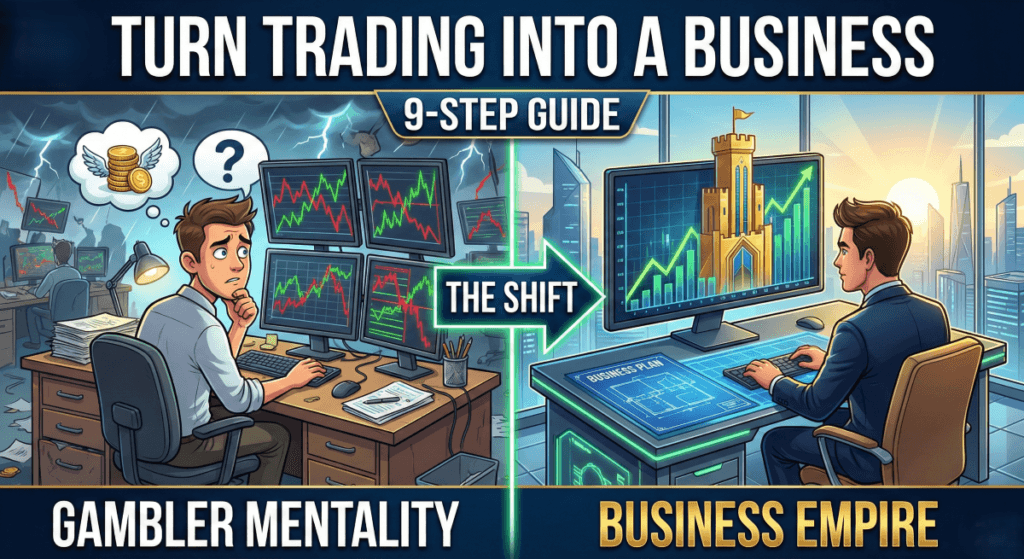
They wake up in the morning, open the chart, hear some news from somewhere, see someone’s signal, and put money there. They don’t consider whether this trade fits into their plan. There is no system, no risk framework.
This carelessness leads to consistent loss. Consider this: If you are a restaurant owner, will you randomly make a dish and sell it?. No. First, you decide which cuisines to sell—South Indian, North Indian, Chinese.
You determine who your target audience is, where the location should be, how much capital it will take, and your daily expenses and expected profits. Similarly, you should approach trading in the same way: like a fully structured business.
Step 1: Market Selection
First, you need to know which market you will trade in. There are many markets: stock markets, options markets, forex markets, crypto markets, futures markets, and commodities markets. Many new traders want to learn everything together. They want to try crypto today, options tomorrow, and forex the day after tomorrow.
What happens in the end is total confusion and no depth. In trading, depth is always more powerful than width. Choose one market and become an expert in that market.
Every market has different psychology, volatility, timing, and risk.
Forex has high leverage, and movements are unpredictable.
Options have a time decay factor, which requires discipline.
Crypto has volatility, which you have to adjust to.
Every market should be chosen according to your personality, availability, and learning style.
Step 2: Asset Focus
Once you have decided on a market, the next step is determining which asset or instrument you will focus on.
- If you are an intraday trader, will you trade only Nifty and Bank Nifty, or select stocks?
- If you are in forex, will you focus only on major pairs like EURUSD or GBPUSD, or will you also trade exotic pairs?
- If you are an option trader, will you trade on expiry dates, or will you take swing trades?.
Without this clarity, you will see new assets every day. Every time, your mindset and strategy will change. The biggest loss in trading is not due to strategy; it happens due to confusion. Choose a simple, focused asset basket for yourself consisting of 3-6 instruments whose movement, behaviour, and volatility you remember inside out. The more you observe them, the faster you will be able to read their setup, and you will be able to execute without panic or lack of confidence.
Step 3: Capital Planning
When you have chosen a market and decided which asset or instrument to focus on, the next big question is: how much money are you going to invest in your trading business?. This question is as simple as it looks, but in reality, it is emotional and strategic.
Every person’s financial situation is different. Someone has Rs. 75,000, and someone has Rs. 6,00,000. But for everyone, that amount has a different importance. You have to decide whether that money is your emergency savings, whether that money has been saved from your salary, and whether you are emotionally ready to lose that money.
Capital Selection Rules
Trade with an amount you can emotionally afford to lose. When a smart person starts a new business, they test first. They observe the market and operate on a small scale. When the system starts working, they scale it up. This is the mindset you have to adopt in your trading.
If you have Rs. 2,00,000, you should not put it in the market. As soon as you put all this money into trading, your heartbeat will increase.
- Every time the price comes down, there will be anxiety and a little loss.
- There will be revenge trading.
- Every time there is a profit, greed increases, leading to a little more.
This emotional roller coaster will stop you from becoming a profitable trader. Start smart learning. If you are starting, a small amount like Rs. 15,000 to Rs. 30,000 is sufficient—so much so that even if you lose it, there is no problem in your life. If there is a profit, it will validate your learning.
Most importantly, keep that selected amount fixed for the next 8 months. Commit to yourself to start with a specific amount (e.g., Rs. 25,000) and trade only with this capital for the next 8 months.
- You will stay away from pressure.
- Emotional detachment will be built.
- You will start seeing trading from the master’s perspective, not from the perspective of money.
- Your focus will be on the process, not on the outcome.
Step 4: Risk Management
Controlling your losses is the real game in trading. Now that you have decided on the market, asset, and capital, the next game-changer question is how much risk you will take on every trade. This is where the difference between a beginner’s mindset and a professional trader’s mindset begins. If you don’t understand risk, then your game is over.
Profit does not make you rich; risk management keeps you alive. Staying alive in trading is the first condition for winning. Many people think that professional traders always run after big trades, but the truth is that they keep their losses within strict boundaries that allow them to survive systematically.
Then, the compounding goes in their favour. The golden rule is to protect your capital at all costs. This rule is the foundation of your trading and the business’s first policy. If you save money, you will get a chance tomorrow. If you lose money, then everything is lost.
The 1.5% or 2.5% Rule
The next step is to adopt the 1.5% or 2.5% risk rule. If you have started with Rs 50,000, the most important and first discipline is to keep the risk per trade to a maximum of 1.5% or 2.5%. For example, with Rs 50,000, 1.5% is Rs 750. This means that no trade can take more than Rs 750 from your pocket.
This is important because there is a loss in trading. None of the 50 trades can win 50 times. But the one who survives is the one who increases through compounding. The 1.5% rule means that even if you take 4 trades in a row, it will only reduce your account by 6%, not 40%.
Uneven Risking
A common mistake beginners make is uneven risk-taking. In one trade, they take a risk of Rs 3,000; in the next, Rs 800; in the next, Rs 1,800. The result is no consistency or pattern. The system cannot be measured or scaled.
The solution is consistent risk, which equals clear data. When you trade with the same risk amount in every trade, you get clear data on what your strategy is, where there should be improvement, and in which trade you are getting more of an edge. Most importantly, your mind remains peaceful because you already know the maximum loss.
Beginner’s Wisdom: Ask yourself: Am I mentally ready to lose Rs 250-500 in a day?. If yes, then it is fine. If not, then either reduce the risk or avoid trading. Trading without emotional readiness is a loss.
Step 6: A Solid Business Plan
If you take a small risk in every trade and follow it consistently, even after 9 months or 2-3 years, you will remain in this market. Why? Because you have considered your loss as a part of the system. Small losses do not break your confidence; in fact, they show you that the real strength lies in long-term consistency.
A common mistake is over-risking with small amounts. Many traders with account sizes ranging from Rs 20,000 to Rs 80,000 take a risk of Rs 6,000-8,000 in every trade. The result is that, after 3-4 trades, their account is halved.
Foundation of a Real Trading Plan
The biggest question is what does your trading business plan say?. There are 3 fundamental pillars in a good business plan: Strategy, Setups, and Self-awareness.
1. Strategy
Strategy tells you how to read the market. Do you work on price action?. Do you trust indicators?. Do you use order flow, volume profile, or SMC?. Strategy does not mean entry-exit.
2. Setups
A setup is not just about entry and exit; it depends on risk management and psychology. You must define your ready-to-go trading toolkit. What is your go-to setup?. Under what conditions do you trade, and when do you avoid?. Do you have a list of pre-defined A+, A, and B grade setups?. Those who have read the 140 setups in our community would know what a setup is. Setups are those that make you decisive, not reactive.
3. Self-awareness
This is the first and most complicated question: What type of trader are you?. Are you a scalper, day trader, swing trader, or position trader?. This decides which time frame you will use, your strategy, your risk, and your patience level. The time frame reflects your trading nature.
Scalping happens on a 2-4 minute chart.
Day trading is done on a 10-20 minute chart.
Swing trading is done on a 2-5 hour or daily chart.
Position trading is done on a weekly or monthly chart.
Choose a time frame that matches your lifestyle, psychology, and execution style. If you don’t have the ability to make fast-paced decisions, a 1-minute scalp can be a disaster for you.
Avoid Random Switching
Avoid the style of 2-day swing trading, 3-day scalping, 4-day option buying, then option selling. This style will not take you anywhere; it will only leave you frustrated and inconsistent. Choose one strategy and master it. Understand it deeply, gather data on its setup, and, once you gain confidence, build a system around it. Then you will trade with clarity and conviction.
Flexibility is allowed, but the framework is important. If you are a scalper and want to become a swing trader after 5 months, it is not wrong to follow a strategy for 5 months. It is not a rigid system, but you should develop a structured one. The framework can change, but it is necessary for you to be learning, measurable, and directional.
Step 8: Track Your Threats
Data is your true teacher. If you build a strong structure now, your life will become easier in trading after a few months because you will know what is working in your setup, what is not, and where you need improvement. In the future, if you have to make a change in your strategy, those small changes are sensible.
However, if you start trading without any strategy or system, you will get stuck in a chaotic cycle of confusion, frustration, and losses at every step. You will not understand why your performance is the way it is.
Step 9: Track Your Business Like a Real Business
Suppose you start a new business tomorrow. Will you just do blind guesswork?. No. You will check your business daily. You will look at the profit from which product, which day your sales are higher, which day your business is not working, where the cost is going, and what the strengths and weaknesses are. You know all this because you have data.
We should adopt this in trading as well. The best way to do this is to maintain and track your journaling. Maintain every trade in a journal, whether it is small or big. You can maintain your trades and journals on Excel or in a diary. Analyse your evening based on that data.
Review the performance every week and analyse the details: Where did you enter? Where did you exit? What was your mindset at that time? What was the logic behind that trade? What was the setup? Did you do it according to the plan? Or did you create unnecessary emotions?
When you start doing this continuously, the real magic starts. You become your own aesthetic mirror. You can clearly see where you went wrong, when you gave your best, which are your weak days, and when your accuracy improved. You will discover your best strategies—you will likely do a good job in 3-6 strategies. Which setup is failing you again and again?. Under what conditions are you over-trading, and what is your average hold time? You will see how long you are staying in loss versus how long you are staying in profit.
Journaling is not just about tracking numbers; it is the best way to understand your psychology. Do you trade in boredom?. Do you trade at a loss after overconfidence?. Do you trade discipline after a winning streak? This pattern comes when you sit face-to-face with your journal. If you haven’t started journaling yet, you are missing half the game of trading. Until growth is measurable, it is not scalable either.
Developing a Process and Structure
To succeed, you must treat trading like a real business. Trading is not a time-waster you do part-time; it is a 100% serious profession. Data speaks. If you ask any successful trader, they can tell you without hesitation why they took a reversal, why a strategy performed well, or why they lost—because they have data.
You should have a process and structure that includes the three most important things:
1. Internal Meeting with Yourself
Hold a meeting with yourself: a daily recap, weekly review, and monthly self-analysis.
2. Discipline Through Scheduling
This should be clear on your calendar. Use time blocking. Book a slot in the calendar for when to trade, when to learn, when to review, and when to take a rest. If you don’t make your routine, the market will turn you around.
3. Education
This is not just market-based (charts and indicators), but also self-based. You must understand your internal psychology. How is your mindset?. In which emotions do you perform better?. In which situation do you become impulsive?. When do you trade in boredom or in FOMO?. The more you understand yourself, the better decisions you make.
Reflecting on the journey, one might wish they had treated it like a business from the beginning of their trading career, rather than taking 3-4 years to realise it. The real growth begins when you stop just changing things—strategies, capital, asset classes—and start building a foundation. Without a foundation, there is only chaos and frustration. Structure your trading business today, because only those who take it with full sincerity, seriousness, and structure achieve success in this profession.