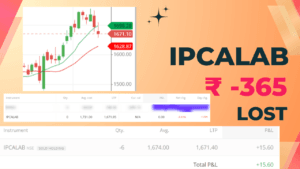

It is 2:45 in the afternoon. There are only 45 minutes left until the market hour closes. The profit is also around Rs 6,500. Our target today was Rs 6,000, and we have also met it. But at 2:45 PM, a setup is being made according to your criteria. The same setup is being made.

Now you tell me: Will you trade that day or leave it? Because today you have made Rs 6,500 in 3-4 trades. There is no overtrading. Then what will you do? Will you go for the round figure of Rs 7,000? Will you take a trade and complete Rs 7,000? Or will you leave the trade? You will think today’s target has been set, and that we will trade tomorrow.
The Psychology of the Late-Day Trade
Look, 85% of people make mistakes here. What will they do? Their target has also been completed. Everything was good for them. But they make mistakes because the setup is being made according to them. And in the mind, when Rs 6,500 has been made, then why not make it Rs 7,000?
This is the biggest mistake. What happens is that as soon as you make an entry, where you were doing well in the setup every day, that day, unfortunately, the trade goes wrong. And your Rs 6,500 after the loss, how much is left? Rs 3,500. Now you didn’t even expect this Rs 3,500. You didn’t even think about the loss. What did you think? You thought about Rs 1,500 profit.
And what happened? Where Rs 3,500 profit happened, your psychology will go wrong. What will you do? To fulfil that target, you will start fighting the market. Since it is the day of expiry, theta decay will occur very quickly. As soon as your Rs 6,500 to Rs 3,500 comes, you will increase the quantity. You will go to OTM. You will start trading on the low premium strike price. Why? Because you have to do Rs 6,500 immediately. Because you have already seen Rs 6,500.
This is where the overtrading starts. If you were in a profit of Rs 6,500 till 2:45 PM, at the end of the day, you might have lost more than Rs 6,500. And then, you hold your head and think, ” Why did I do this? You regret and blame yourself. All these things will happen to you. You were in a good mindset till 2:45 PM, and at 3:15 PM, you became in a bad mindset.
Overtrading is a dangerous disease. Stopping overtrading is just a game of patience, or there is a proper system behind it: discipline and trader mindset.
Point 1: Fix Your Daily Trade Limit
Believe in quality more than quantity. When Bank Nifty gives an intraday move of 450 points, you naturally think that if you leave this move, you will miss it. But in options, not every move makes money. There is premium decay, bid-ask spreads, and small pullbacks that often turn your profits into losses.
Professional traders fix their daily trade quota. Minimum 2 trades per day. No matter how tempting the market is. Not every market move is tradable, and every trade puts capital at risk.
Consider this scenario: A trader took a C in Nifty 50 at 9:35 am. SL hit on the breakout setup. Reversal PE on 2nd trade at 10:15 am. SL hit again. If his quota is 2 trades, he has to wait for a high conviction setup before taking the 3rd trade. He doesn’t have to do a random entry. But often, people get trapped due to random entry. The daily quota rule should be strict. This is the entry point of overtrading.
Point 2: Set Targets for Profit and Loss
Daily circuit breakers, greed, and frustration are the reasons for overtrading. In profit, a trader thinks he can earn more. In loss, he has to take back. Results are the same in both: impulsive trades.
Don’t take more than a 2-3% risk of capital. If the capital is 2 lakh, then the maximum is 5,000 per day.
Set a fixed profit target. As soon as it is hit, switch off the terminal. For example, a trader took 1 trade at 9:35 am. He made a profit of 2,500. The target was 3,000. But he thought momentum was strong, so he took another step. Next trade, loss of 4,500. The day went red. If the target had stopped as soon as it was hit, the day would have been green. Psychology would have been positive.
Set profit target and loss limit on the chart. Before every entry, remind yourself what to do.
Point 3: Take Trade on Predefined Setup
No setup, no trade. Option traders think something is happening in every candle, but it’s just an illusion. Taking entry on every small move without a strategy is gambling.
Create 2-3 tested strategies, such as breakout-plus-retest, FEZ fill, or Y-Change analysis. If that setup doesn’t work, wait until the end of the day. No problem. No trade day. It was a profitable day because you didn’t lose.
Imagine a trader who trades Bank Nifty every 30 minutes. His setup is 30 mins breakout plus retest. One day, the market was sideways. He didn’t make a setup. But he took 8 trades in boredom. If he had followed his rule, he would have lost 0. Make a setup checklist. Until a 5-point condition is satisfied, don’t take the trade.
Point 4: Maintain a Trade Journal
A trade journal is so important that you can’t imagine it. The habit of over-trading is revealed when you autopsy your own trade. The journal is a mirror. It shows which trade was genuine and which was taken in boredom or revenge mode.
Note every trade’s entry time, exit time, reason, and market condition. Do the analysis at the end of the week. Trades with vague reasons are a major cause of over-trading.
A trader maintained a journal for a month. He found that 45% of the trades’ reason was that the market was strong. This trade was responsible for 70% of his total loss. Think about it. Note the journal on Google or in a book so the weekly review is easier.
Point 5: Take a Break and Reset
Take a break and get away from the market. Emotions cool, decisions cool. If emotions are cool, decisions will be cool too. Every trader’s revenge mode turns on, and the mind thinks of only one thing.
Stop trading on the same day after 3-4 consecutive losses. Do physical activities like walking, going to the gym, or meditation to help you reset emotionally. Save capital.
If the market opens and you take entry on every small candle as soon as 2 SL hits, you may end up with a total of 12 trades and a loss of Rs 15,000. If you had taken a break after 2 losses, the damage would have been Rs 3,500. If you want to improve this, don’t look at the terminal all day if there’s a loss in the morning. Don’t trade every move on the 1-3 minute chart. For decision-making, stick to a 30-60 minute time frame. This will help you avoid trading in small pullbacks.
A Structured System for Success
Controlling over-trading is not just a game of patience; this is a game of a structured system. Write rules, follow them strictly, and don’t give yourself permission to take extra trades. In the market, common trade and high profit are the real formula for sustainable success. All pro-traders do this.
Here is a checklist to stick somewhere each day to help you curb overtrading and improve your trading psychology.
Pre-market Preparation
- Make a checklist before 9:00 am.
- Set a quota of a maximum of 2-3 trades.
- Set a daily loss limit.
- Set a capital limit of 1.5%, 2.5%, or, if you are risky, 5%.
- Set a daily profit target. If your target is achieved, then stop trading.
- Check daily news events. Check if there is no RBI policy, no expiry date, and no US data.
The 20-Second Rules Before Every Trade
If the answer is yes, then take the trades.
- Is this setup following my strategy?
- Have I marked a clear entry and stop-loss on the chart?
- Is the position size within my risk management rule?
- Is this trade being taken because of FOMO or revenge?
If even one of these is no, then the trade is cancelled. Don’t even take the trade.
Impulse Control During Trading Hours
- Don’t exceed the quota.
- If two consecutive SL hits, trading is stopped.
- Don’t increase the position size to recover the loss.
- After every trade, pause for 5-10 minutes and stay away from the screen.
- If there is any news or rumour, don’t take the trade on that. Take a setup-based trade.
Post-Market and Weekly Review
At the end of the day, review:
- How many trades did you take today?
- Did you exceed the quota?
- Did you breach the loss limit?
- Did you take the trade after the profit target hit?
- Did you write the reason for every trade in the journal?
- Did you note what to improve for tomorrow?
On the “Weekend special” weekly review , analyse the trades of the last 7 days. How many trades did you take without a setup? How much loss did you get from those impulsive trades? If those trades were avoided, what would be the P&L?
The Decision Flowchart
Paste this flowchart on your monitor. Under it, write: No setup, no trade. Quota over. Stop. These small reminders in the live market give you a break.
- Is the market open?
- Is today’s quota left?
- If no, then terminal ban.
- If yes, proceed.
- Is the setup ready?
- If no, then wait.
- If yes, is the SL defined?
- If no, then cancel the trade.
- If yes, proceed.
- Is the trade from FOMO or REVENGE?
- If yes, then cancel the trade.
- If no, then take the trade.