

The Foundation of Profitable Trading
If you want to understand the technical game of the stock market, then you have to master the chart. And you have to understand the hidden story behind the price in detail. Because the chart is the basis of the stock market.
If you understand it well, then you will not need any strategy. People run after indicators worldwide. If you learn chart reading at a pro level, you will never need any indicators. Only charts and psychology can make you profitable.
But you will not be able to become a master of chart reading until you understand the structure of the market deeply.
Understanding Uptrend Market Structure
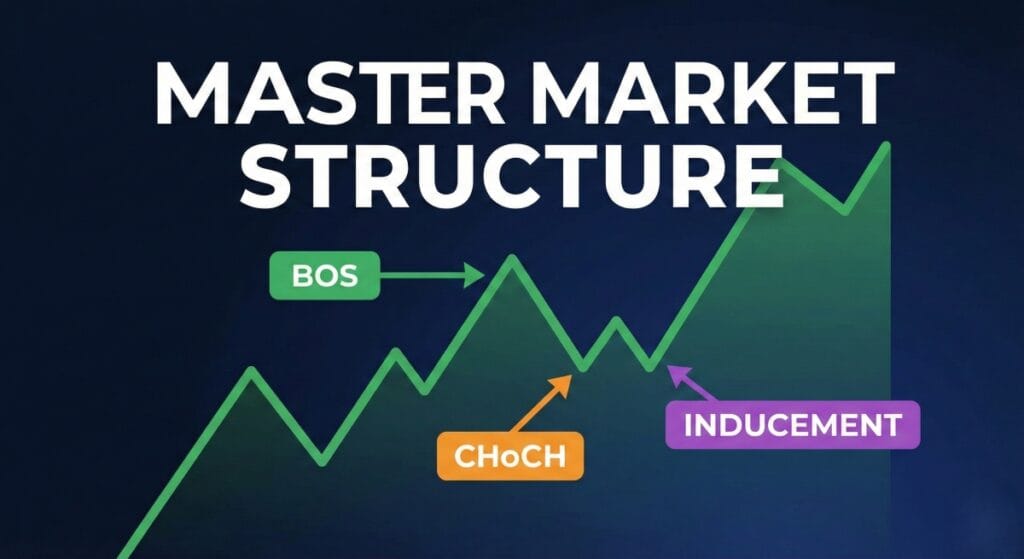
Whenever the price is making higher highs and higher lows, we say the market is in an uptrend. Let’s say we have a price that is making higher highs and higher lows. Then it is making a higher high, then a higher low, then a new higher high.
At this point, there is a break in structure, referred to as BOS. BOS, or Break of Structure, simply means the market has moved past the previous high, confirming the continuation of the trend.
You might ask how we will recognize an uptrend. The answer to this is that, like this, the higher low is higher than the previous higher low. And after that, the higher low is also higher than that.
- Every new high is higher than the previous high.
- This means that the market’s structural point is shifting upwards.
- This is why we call it an uptrend.
Breakup Structure (BOS) and History
Now what do we have? Lower lows, higher highs, higher lows, and then higher highs. This shows that there is a breakup structure here. Because now the price is trading above the previous high. This means that the price is trading between this low, this high, and this high.
Remember, whenever we trade in this kind of market, you have to make a history of the first market. Then you have to take a trade.
Just as you read books from left to right, you also have to read the market from left to right. This means you should know the history of the previous prices leading up to the current price. This is why, when you are marking on the chart, it is very important to understand the history of the previous market. Here, the price made a higher low and then a higher high, which broke the previous higher high. This point is called the breakup structure.
Impulse and Pullback Waves
Assume you are trading this chart from the 1-hour to the 5-minute time frame, which is an intermediate time frame. So first of all, we will mark the chart on a 1-hour time frame. And then when you go to the lower time frame, you will know whether you are trading a pullback or an impulse move.
This is a pullback.
This is an impulse.
- Then there is a pullback, then an impulse.
Traders call this by many names. So we don’t have to get confused in terms and names. The most important thing is that you understand what the market is doing at that time and what it did in the past, so that you can mark your charts correctly.
Change of Character (CHoCH) and Reversals
As long as the price trades above this area, we remain in a buy position. But if the price breaks the previous higher low and closes below, this signals a Change of Character, or CHoCH. CHoCH means the market’s direction may be reversing from an uptrend to a downtrend.
Now see, the price goes down and closes below the previous higher low. This is called a change of character, or you can also call it a reversal from an uptrend to a downtrend.
Earlier, the price was making higher highs and higher lows. And this is the last higher low. This only broke the previous higher high. Now see that this price, instead of making a higher low, makes a lower low.
If this happens, we assume it is a reversal or a change of character.
Trading the Reversal: Supply and Demand
Now, when we see a change of character, the price usually comes back. Where does it come back?. Reversal area or supply zone.
Because in the end, there are only two things left in the market: Supply and Demand. Everything else will confuse you. You just have to see where the price can reverse. That is your point of interest, which we call POI.
Downtrend Market Structure
We will understand what the downtrend market structure looks like in reality. When the market is in a downtrend, it falls like this. First, we see a high. Then, below that, we see a lower low. Then we see a lower high. Then, below that, we see a higher high.
So if there is a lower high below a higher high, then it is called a lower high. This is a downtrend market.
A trader’s responsibility is to identify the market’s direction. What is the market situation? Is it trading in an uptrend or a downtrend?
If you are unable to identify the direction of the price, you will take a trend in the wrong direction. You will blow your account as you often do.
It is very important for any trader to learn how to properly map the market structure.
Validating Breaks and Avoiding Fakeouts
Next, we need to see how long the price has been trading in this range. This is the range from lower high to lower low. And until the price does not go above this lower high, assume this is a downtrend market. This means that even now, you only have a sell position, or you can say you have to look at the bearish trend.
But if the price breaks this line, it could signal a continuation of the downtrend. And this can be a liquidity hunt. Or it can also be a fake-out. Always keep marking your breakup structure.
Remember, the last high is not confirmed until we get a higher low.
The Importance of Candle Closure
When you are looking for a change-up character, it is very important to wait for the candle to close. Whether you are looking for a change-up character or a break-up structure. Especially when you are looking at a high time frame, you should always wait for the candle to close.
- With this, you get a good confirmation.
- That this is not a fake-out, but it is a true move that will continue.
If this candle did not close above the last lower high, this is not a valid change-up character . That’s why when you are trading below this line, you are also in a downtrend. If the price closes above this line, you can consider it an uptrend or a change-up character.